Alopecia Areata Treatment in Islamabad
A smooth, round bald patch on the scalp can be very frightening. It can appear in the space of a few days or even overnight. Most cases of alopecia areata (hair loss) are not permanent and can be treated. Hair is allowed to regrow.
Quick Facts About Alopecia Areata
What is it? | An autoimmune condition that causes sudden patchy hair loss. |
Is it contagious? | No |
Who gets it? | Children, teens & adults. All genders. |
Can Hair regrow? | Yes, if hair follicles stay alive. |
Treatments? | Topical medication, Oral medication, PRP, LLLT |
Results lasts? | It takes 2 to 4 months to see early signs and longer for full regrowth. |
Number of sessions? | Depends on treatment type. |
Can it come back? | Yes, follow up is required. |
Cost | Depends on the treatment type and sessions required. |
What Exactly is Alopecia Areata?
This is an autoimmune disease. In people with Alopecia Areata, their immune system treats their hair follicles as foreign and attacks them. The hair follicle rapidly shrinks and stops hair from regrowing for a period of time. The good thing is, the hair follicle is still present in the skin.
It can show up in different ways:
- Patchy Type: One or more patches of hair loss, usually in a circular shape. Hair in and around the patches has fallen out in patches.
- Alopecia Totalis: Hair loss on the whole scalp.
- Alopecia Universalis: Hair loss on the whole body.
- Ophiasis: Hair loss on the sides or back of the head.
Can Alopecia Areata Be Treated?
Yes, it can be managed, and often very well. There are many treatments available for this condition. In many cases, it goes into complete remission. Alopecia Areata is an autoimmune disease, meaning that the body’s immune system decides to attack the hair follicles in the scalp. Hair follicles are not destroyed. They just get switched off. So, hair regrowth is possible. Recommended treatments aim to wake up the follicle again. Minor patches can be treated over time with topical medication and treatment. More stubborn patches can be treated with PRP, LLLT, or other prescription. Note that every hair loss is unique and therefore requires a personalized approach.
Causes of Alopecia Areata?
- No single factor has been proven to cause this condition. It is likely that a combination of factors is involved.
- Family history of alopecia areata or autoimmune conditions.
- Genetics. More people are prone to this.
- Hormonal issues like thyroid problems.
- Skin conditions like vitiligo and eczema
- Mental stress or physical shock.
These factors alone cannot create the condition. They sometimes set it off in someone who is already vulnerable.
Signs You Should Not Ignore
- Smooth, round, oval patches of hair loss.
- Inflammation & tenderness
- Excessive sudden hair loss
- Thinning of eyelashes, eyebrows, and beard.
It is worth booking a dermatologist appointment early. Treatments work better when patches are small and recent.
What We Offer for Alopecia Areata
Low Level Laser Therapy (LLLT)
This treatment uses gentle light therapy at the correct depth to penetrate the scalp. It stimulates hair growth. It works by increasing blood flow to dormant hair follicles. It is painless and non invasive. It can be completed in a few minutes. Safe for all ages. Often recommended for children. Best used as part of a broader treatment plan rather than in isolation.
Platelet Rich Plasma Therapy (PRP)
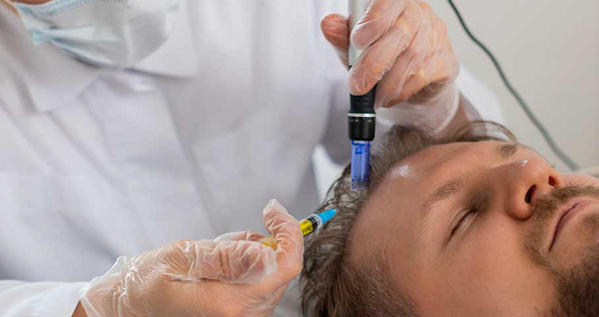
It involves taking a small amount of your blood and placing it in a special centrifuge. This process separates the platelets from the other blood cells. The resulting plasma, rich in growth factors, is injected into the areas of baldness on the scalp. As it is derived from the patient’s own blood, there are very few chances of side effects. You may feel slight redness or tenderness, which is normal and will settle in a few hours.
Oral Medication
Depending on the condition, our expert doctor may consider oral medication to reduce immune system activity. However, medication will require assessment and blood test.
Topical Medications
In this treatment, patches can be covered with cream, lotion, or foam. This treatment is gentle and easy to use. This is often recommended for children or cases of mild alopecia Areata. This treatment may take a little longer than medication treatment.
Support Care
Other things that could affect your hair loss include low levels of vitamin D, Iron deficiency, or an underactive thyroid. We always check all things that can get in the way. Prescribe accordingly, with gentle hair care, stress management, and good sleep. It helps in overall condition.
How Does the Treatment Plan Work?
Consultation & Scalp Assessment | Our expert doctor takes note of the pattern, size, and age of hair loss. They take medical history. |
Test if needed | Simple blood test or thyroid test to check the root cause. |
Customized Plan | According to your condition and goals, the doctor will make a customized plan for each patient. Because hair loss is different for everyone. |
Regular Follow ups | To track regrowth and keep an eye on patterns and treatments. Follow up is required as suggested by the doctor. |
Alopecia Areata Treatment Cost in Islamabad
The cost of alopecia areata treatment depends on the degree of baldness, the chosen form of treatment, and the likely number of hair loss treatments needed. The exact cost will be confirmed at your consultation. You will always get the right price before the treatment at DFA Clinic.
Why Choose DFA Clinic for Alopecia Areata Treatment?
- Individual attention: Your plan is built around you because every hair loss is different.
- Honest conversations: Our expert doctor will give you honest advice on treatment according to your hair goal.
- Several options under one roof: From topical medication to treatment for excessive hair loss. DFA Clinic covers it all.
- Gentle approach for all ages: DFA Clinic treats alopecia Areata for all ages and genders.
FAQs
Not usually. Hair often regrows with right treatment and approach.
PRP may help some patients, especially when combined with other treatments.
Yes. For kids, we usually start with gentle options such as topical treatments and LLLT.
As soon as you notice sudden patches, spreading hair loss, or loss of eyebrows, eyelashes, or beard.